Description
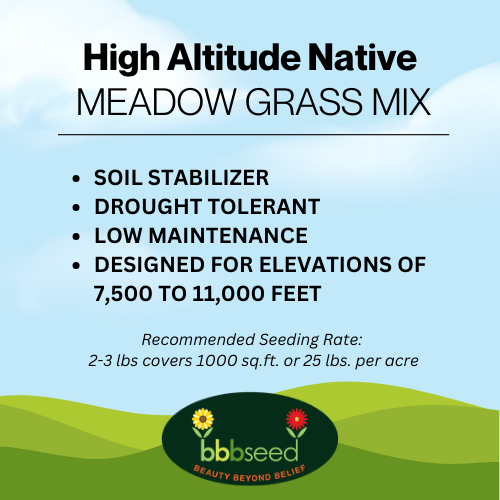
We designed our High Altitude Native Grass Mix for mountain properties where standard grass seed often falls short. This blend is composed of 75% native grasses commonly found above 8,000 feet, reaches 12 to 18 inches tall, and forms a natural meadow-style stand with a mostly bunch-grass habit. Once established, it is drought-tolerant and lower maintenance than introduced grasses, making it a strong fit for high-elevation landscapes that need a more natural look.
Quick Specs
- Origin: 75% native grass blend for elevations above 8,000 ft
- Mature Height: 12 to 18 inches
- Growth Habit: Mostly bunch grasses
- Best Fit: High-elevation meadow-style plantings
- Planting Window: Spring or fall
- Soil Temperature at Seeding: 50 to 80°F
- Site Prep: Firm, well-drained seedbed
- Available Sizes: 1 lb, 5 lbs, 25 lbs, 50 lbs
- Add Wildflowers: Mix 1/4 lb Rocky Mountain Wildflower Mix with 5 lb grass mix
- Seeding Rate: 2-3 lbs. per 1,000 sq. ft. or 25 lbs. per acre
Why?
We use this mix when the goal is a resilient planting for mountain conditions, not a conventional low-cut lawn. It gives buyers a native-looking stand, a meadow feel, and lower long-term maintenance once the planting is established.
Where?
This mix is best for sites above 8,000 feet where a taller, naturalized stand is preferred. It also works well in meadow-style landscapes and in plantings paired with Rocky Mountain Wildflower Mix for added seasonal color.
When?
Plant in spring or fall when soil temperatures are between 50 and 80°F. This planting window gives the seed the best chance to establish under mountain conditions.
Water?
Keep the seedbed consistently moist during germination and early establishment. Once established, these grasses require less supplemental water thanks to their natural drought tolerance.
Best Planting Season:
Spring or fall is best for seeding the High Altitude Native Grass Mix. We recommend planting when soil temperatures are between 50 and 80°F.
Easy Planting Instructions:
- Prepare the site: Remove weeds and large debris.
- Fertilize (optional): A starter fertilizer can support early growth.
- Spread seed evenly: Apply half the seed lengthwise, then half crosswise using a drop or broadcast spreader.
- Cover lightly: Support good seed-to-soil contact by lightly raking or watering in.
- Water during establishment: Keep the newly seeded area moist at all times during germination and early growth. If irrigation is limited, very early spring seeding can help you capture natural moisture.
- Mowing: This grass mix doesn’t perform well with consistent mowing. Let seed heads dry before mowing or cutting. Do not cut the stand below 6 inches, to allow the seed to disperse naturally.
Growth Requirements:
- Best suited to elevations above 8,000 ft
- Needs a firm, well-drained seedbed
- Plant when soil temperatures reach 50 to 80°F
- Keep moisture consistent through germination and early establishment
Germination Timeline:
Because this is a multi-species mountain blend, germination will be staggered rather than perfectly uniform. Moisture plays a major role in how quickly the stand starts to fill in, so keep the seedbed consistently moist until seedlings are well underway.
Seeding Rate:
- New seeding: 2 to 3 lb per 1,000 sq ft
- Acreage rate: up to 25 lb per acre
- 1 lb covers about 333 to 500 sq ft
- 5 lbs covers about 1,667 to 2,500 sq ft
- 25 lbs covers about 8,333 to 12,500 sq ft
- 50 lbs covers about 16,667 to 25,000 sq ft
Overseeding and Renovation:
For bare spots or thin established areas, overseed in spring or fall. Cut existing growth back, rake the surface well, and seed the gaps to help thicken coverage and reduce weed pressure.
Common Mistakes to Avoid:
- Seeding outside the 50 to 80°F soil temperature window
- Leaving seed on the surface instead of lightly raking it in
- Letting the seedbed dry out during germination
- Cutting the stand too short before the seed heads dry and disperse
Sheep Fescue: Adds fine texture to the blend
Mountain Brome: Adds cool-season body
Slender Wheatgrass: Helps broaden site adaptability
Intermediate Ryegrass: Supports early establishment
Tufted Hairgrass: Contributes to the tufted meadow character
Upland Bluegrass: Helps round out density
Idaho Fescue: Adds native mountain texture
Rocky Mountain Fescue: Reinforces high-altitude character
Dahurian Wildrye: Adds structural contrast
Prairie Junegrass: Helps keep the mix balanced
Mix contents and varieties may change based on availability. Call for current varieties when exact species selection matters for your project.




Reviews
There are no reviews yet.