Description
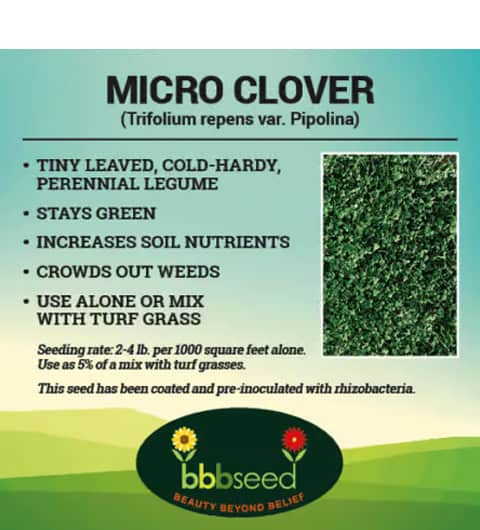
Micro Clover, Trifolium repens var. ‘Pipolina’, is a refined lawn clover we offer for homeowners and landscapers looking for a greener, denser, lower-maintenance lawn. This smaller-leaf clover works well as a stand-alone lawn or blended with turfgrass, where it helps improve color, supports natural nitrogen contribution, and encourages a fuller surface that stands up well to routine mowing. Its pelletized seed is easier to handle and spread, making it a practical choice for new lawn projects, lawn renovation, and overseeding.
Quick Specs
- Botanical Name: Trifolium repens var. ‘Pipolina’
- Common Name: Micro Clover, Mini Clover
- Seed Type: Pelletized
- Life Cycle: Perennial
- Growth Habit: Low, spreading, turf-friendly clover
- Leaf Size: About one-third smaller than standard white Dutch clover
- Mature Height: 4 to 6 inches if left unmowed
- Bloom Color: White if left unmowed
- Bloom Time: Mid-summer
- Sun: Full sun to part shade
- Soil: Adaptable to a range of lawn soils with good drainage
- Available Sizes: 1 lb and 5 lb
- Use: Stand-alone lawn or about 5% of a turfgrass mix
- Seeding Rate: 2 to 4 lb per 1,000 sq ft
Why?
We recommend micro clover for lawns that need better density, lower fertilizer demand, and reduced watering once established. Its low growth habit and smaller leaves give it a neater lawn look than standard white clover, while its spreading habit helps fill in open areas and compete with weeds.
Where?
Use it in home lawns, low-input landscapes, and lawn renovation projects where you want a softer, greener surface with less maintenance. It performs well on its own and pairs well with turfgrass when you want a blended lawn that looks fuller and stays greener with fewer inputs.
When?
Spring and early fall are the best planting windows. Seed when conditions are mild and warm enough for steady germination and root development.
Water?
Keep the seedbed evenly moist during germination and early establishment. Once rooted in, micro clover needs less water than many traditional lawns and performs best with deep, less frequent watering.
Best Planting Season:
Spring or early fall, when conditions are mild, and soil moisture can be managed consistently during establishment.
Easy Planting Instructions:
- Prepare the site: Remove weeds, debris, and excess thatch. If you are overseeding, mow the existing lawn closely first.
- Build the seedbed: Loosen the top surface lightly so the seed can make good contact with the soil. A firm seedbed is better than a fluffy one.
- Spread seed evenly: Apply half the seed in one direction and the remaining half across the first pass for more even coverage.
- Press seed into place: Rake or roll lightly so the seed is tucked into the top surface without burying it too deeply.
- Water during establishment: Keep the soil surface consistently moist until germination and early rooting are underway.
- Watch for germination: In warm conditions, micro clover typically germinates in 5 to 10 days.
- Begin mowing as needed: Once the planting is established, mow to maintain the look you want. For a tidy lawn appearance, keep it around 2.5 inches or lower.
Growth Requirements:
- Full sun to part shade
- Adaptable to many lawn soils with good drainage
- Consistent moisture during germination and early establishment
- Suitable for stand-alone use or mixing with turfgrass
- Handles regular mowing well once established
Seeding Rate:
- New stand: 2 to 4 lb per 1,000 sq ft
- Mixed with turfgrass: Use micro clover at about 5% of the total seed blend
- 1 lb covers about 250 to 500 sq ft, depending on how thickly you seed
- 5 lb covers about 1,250 to 2,500 sq ft
- Germination: about 5 to 10 days in warm temperatures
Overseeding and Renovation:
For existing lawns, mow very low and rake, dethatch, or aerate enough to open the canopy before seeding. A light topdressing can help improve seed-to-soil contact. Early fall is especially useful for filling thin spots and refreshing lawn density.
Common Mistakes to Avoid:
Do not let the seedbed dry out during germination. Avoid burying the seed too deeply, and avoid broadleaf herbicides that can damage clover. Do not overfertilize with nitrogen if your goal is to keep micro clover active in the lawn mix.
Botanical Name: Trifolium repens var. Pipolina
Plant Type: Perennial lawn clover
Leaf Size: Smaller than standard white Dutch clover
Growth Habit: Low, spreading, stolon-forming cover
Bloom: Small white flowers if left unmowed
Height: About 4 to 6 inches unmowed
Seed Form: Pelletized for easier handling and distribution
Nitrogen Role: Helps support a lower-input lawn system
Lawn Use: Stand-alone clover lawn or blended with turfgrass
Maintenance Benefit: Lower mowing, fertilizer, and water demand than many traditional lawns