It’s dandelion season!

Dandelion Love

by Sandy Swegel

Let them grow, let them grow, let them grow.

Warm sun after a winter rainy day means dandelions arise from the deep and fill the neighborhood with bright yellow cheer. In the olden days, gardeners might panic at the sight and rush out with their dandelion digger (imagine how primitive people used to think….making a tool for the sole purpose of killing one kind of plant).

Kids were the first humans to know that dandelions are our friends. They brought in freshly picked flowers for their moms or blew dandelion puffs all over the yard. But we adults have learned to love, love, love dandelions.


Because our friends the bees and lots of other critters love them.

Bees love dandelions.
Dandelion flowers are the first food for bees. There’s not much to eat yet in Spring and a field of dandelions is the bee-equivalent of an all-you-can-eat Sunday buffet. And it’s not just the dandelion nectar the bees want….it’s the high protein pollen that really fills the bees up. Paleo bees.

Birds love dandelions.
Birds love the high protein seeds, especially little larks and finches who will spend hours tugging the seeds free.

Bunnies love dandelions.
At least if they’re eating dandelions, they’ll leave your crocus alone.


Humans love dandelions.
Think foraged greens and flowers on salads.

You know who else likes to eat dandelions? Bears do. It’s not uncommon in Alaska to see bears in the meadow eating dandelion heads! Wow.

What a great day. Dandelions are in bloom!

Photo credit: http://juneauempire.com/local/2012-06-19/dandelion-dinner
www.123rf.com/photo_3133074_the-word-bee-spelt-in-dandelions-on-grass.html
www.arkive.org/american-goldfinch/carduelis-tristis/image-G137972.html

It’s Spring. Oh, so Ephemeral!

The Beauty of Spring

by Sandy Swegel

Spring Equinox is officially upon us. All the joys of the season abound. Birds singing, Crocuses blooming, Baby lambs gamboling in the fields outside of town. Yet one of the dearest and most fleeting of Spring delights is the annual blooming of the spring ephemeral wildflowers.

This is a great season to walk through meadows and along forest trails to catch glimpses of great swaths of these very clever flowers. Ephemeral means lasting a very short time or transitory and these flowers that appear above ground for only a couple of months per year are very crafty. They grow in woodland areas and come to life in the brief interval between the end of winter and the time when the deciduous trees start to grow leaves again.  As the sun streams through the bare treetops, hundreds and thousands of flowers throw out wonderful blooms in celebration of their moment in the sun. Wait two months, and everything will be dark and shady in the woods.  But once you’ve walked and maybe danced among the spring ephemerals, you’ll always remember their hidden presence.

If cherry and apple blossoms are starting near you, make haste to the nearest wooded area.  Lots of botanic gardens and parks schedule hikes during these times. The Great Smoky Mountains are home to an especially large variety of ephemerals from February to April.  But even in your own neighborhood, walk along the creeks to find flowers with delightful names like Shooting Star or Trout Lily, Spring Beauty, Trillium and Bleeding Heart.  Keep an eye out for other spring flowers who aren’t officially ephemerals but thrive in the same conditions like Wild Geranium and Pasque Flowers.

William Cullina, author of Wildflowers: A Guide to Growing and Propagating Native Flowers of North America, suggests planting spring ephemerals in early spring or late summer in the shade of deciduous trees. He says to prepare the site by incorporating four to six inches of compost in four to six inches of soil. Well-drained soil, rich in organic matter is essential. And remember to plant as nature does…in broad swaths of color.

Life is ephemeral…. So get out there and enjoy Spring, our most hopeful season. Or as my favorite (if not most poetic) quotation about the season says:

 “Spring is Nature’s way of saying, Let’s Party!” – Robin Williams

Photo Credits:

https://www.flickr.com/photos/mcav0y/166313828/

Early Spring Flowers for Pollinators

Why to Plant These Wildflower Seeds

by Sandy Swegel

Hungry pollinators are starting to wake up. Well, maybe not this week in Colorado if they are smart. We still have a foot of old snow on the ground, but the sun will come out later this week and I expect to see the first crocuses poke out from the melting snow.

The first warm days of Spring bring out lots of our pollinator friends. In a long winter like this, honey supplies are running short and honeybees are eager for fresh food. Wild bees and bumblebees who don’t have honey stores are very hungry. Ladybugs that woke up a few weeks ago and have been eating aphid eggs in the leaf litter are eager for some sweet nectar or pollen. Everybody’s hungry and are flocking to the first flowers to gather nectar and protein. They need to build up their own strength and to provide food for Spring babies.


You can spot some of the first pollinators of the season if you look closely at the first Spring bulbs. Plan to plant more flowers for pollinators in your garden if you want to attract more. You can lure pollinators to your yard by having the first flowers. Then they’ll stay for the rest of the season if you have flowers in bloom all year.


Some of the easiest spring flowers to grow are:
Crocus
Snowdrops
Grape hyacinths
Daffodils
Tulips, especially native tulips.

Little bulbs like snowdrops and grape hyacinths re-seed themselves and naturalize a good-sized patch. If you don’t have these in your own yard, it’s easy dig up a few bulbs from a friend’s overgrown patch and transplant into your own garden. They don’t mind the transplanting too much and will bloom as usual…attracting more pollinators to your yard.

So bend down close to those little crocus flowers to see our pollinator friends. Bring a camera. The bees get groggy from gorging on pollen and are often moving pretty slowly, so it’s easy to get a good picture.


Photo credits:
Mason bee on crocus: http://www.earthtimes.org/scitech/saving-bees-new-pesticide/2612/

Bee on tulip: http://matthewwills.com/tag/honey-bees/

Bee on muscari and fly on snowdrop: http://urbanpollinators.blogspot.co.uk/2014/03/more-early-spring-flowers-for.html

To make your pollinator garden click here!

comp


Design Your Garden with Collages

Decorating Your Garden

by Sandy Swegel

The snow is still deep. Temperatures still below ten degrees. Seeds are ordered. Poppies and wildflowers were strewn on last week’s snow. Garden magazines are read. It’s starting to get hard to occupy the impatient gardener. My irritation with being bored is at about the same level as my neighbor’s 3-year old whose delightful need for attention and distraction sends her knocking on all the neighbor’s doors. Oh to be a pre-schooler again.

I’m past the age where I’m happy playing with crayons or Barbie. But as I watch the clever neighborhood moms coming up with a million games and projects to occupy snowbound children, I decided there was a way I could almost be a pre-schooler again. I could make a collage.

Only in the grown-up world, it’s not called a “collage.” It’s called a “visioning board.” The movie “The Secret” made visioning boards popular. I’m not too big on just having pictures of a perfect garden because, well, I know me. I’m never going to have a perfect garden. I’ll get too distracted by turning the compost pile or watching the bees or running off to do errands to get my garden perfect.


But a Garden Vision Board or Garden Collage is great for keeping track of new ideas and creating imaginary gardens. And all my pretty seed catalogs and magazines have perfect-sized pictures for cutting out small images of flowers and plants that I can paste on my board.

It’s easy to get started.
*Piece of paper, poster board or old cardboard. An old dry erase board and magnets work too
*Scissors (you’re grown up…you can have the pointy ones now)
*Gluestick or tape.
*magazines and catalogs.

So simple but the whole point of visioning is that the process does make your ideas happen. This year some of the favorite flowers or vegetable you collage with now will be growing for real in your yard or pots.

Collage Ideas:
Flowers. Everybody wants more flowers and more color in their yard. Gather pictures of your favorite flowers. Put pictures of flower arrangements so you can remember to grow those flowers.

Garden design. You can collect photos of designs you like. One day you’ll get around to it. My father collected pictures of gazebos for twenty years before he finally retired and had time to build one. I know I will make an herb knot garden one day.

Tweak your mature garden. If you’re ambitious with a printer you can print out a picture of your garden to use as the base of your collage and try out what flowers bring some added pizazz to the nice garden you already have.

Vegetable gardens. The preschooler next door has an electronic game that lets her plant carrots and tomatoes. She’s too young to know we used to design our vegetable gardens with pen and paper in the olden days. Gather pictures of your favorite foods.

Gardening Friends. Or you can just cut out pictures of bees and dragonflies and hummingbirds and all the other pollinators to remind you of your gardening companions.

Vacation Gardens. A collage of all the gardens I could have had if I hadn’t moved to Zone 5 Colorado. Bananas and tropical flowers.

Mostly, I’m collaging to have a little tactile fun and inspiration in the middle of a snowstorm. We have to remember that the reason we started gardening is that it’s fun and beautiful and creative. Not just work to be checked off a to-do list, but a place to nurture our spirit.

Photo credit: http://simplehomecraft.blogspot.com/2012/07/garden-collage.html
http://mamaslittlemuse.blogspot.com/2012/05/designing-garden-from-pictures.html
Pick More Daisies

Daisy Love

by Sandy Swegel

Every January in the middle of some snowstorm, I find a good reason to wander the BBB Seed warehouse to marvel (and covet) huge sacks of seeds waiting to be sorted into packets. There are big sacks of grasses and tiny bags of rare alpine wildflowers. I noticed this year that a whimsical employee who loves daisies had created a shelf of shoeboxes of different seeds that all looked like daisies. What a great idea for a cutting garden!

I started a simple search on our website to see how many daisy or daisy-like flowers we carried and I soon discovered that we are quite obsessed with daisy-type flowers. I found eight flowers named “daisy” and the number soon reached over 25 when I included flowers that look like daisies.

There are good reasons to love daisies beside the fact that they are adorable. Many daisies are also drought tolerant, native, not subject to many pests or diseases and are favorite nectar sources for butterflies and bees.

A short list to get you started on a daisy garden are the flowers with a daisy in their names:

Yellow Daisy (Chrysanthemum multicaule)
Daisy, Shasta – (Leucanthemum maximum)
Daisy, Painted – (Glebionis carinatum)
Daisy, Gloriosa – (Rudbeckia hirta, gloriosa)
Daisy, English – (Bellis perennis)
Daisy, Aspen – (Erigeron speciosus)
Daisy, African – (Dimorphotheca aurantiaca)
Orange Mountain Daisy (Helenium hoopseii)

Then you can move on to the daisy-like flowers such as
Orange and red gaillardia,
Purple and pink echinacea,
Blue and purple asters, and
Two annuals much beloved in American gardens:
Cosmos in pink and white and candy stripe and Zinnias in all colors and sizes.
Finally, cap the season with Sunflowers!

All I can say is, “Hey, Head Honcho Mike! We have a seed mix of poppies (Parade of Poppies). Maybe we need a seed mix next year, “Field of Daisies!”

Photo credit
http://en.wikipedia.org/wiki/Asteraceae
http://www.visualphotos.com/image/2×3894130/a_child_picking_daisies

Pick More Daisies
Best Heirloom Vegetables
Wildflower and Grass Mixes
Native Grasses
Wildflowers


Gardening as Winter Looms

How to Keep Up Gardening in the Winter

by Sandy Swegel

Nothing like the first deeply freezing temperatures followed by a warm day to get people in Zone 5 areas asking if the gardening season is really over if they can still tackle their garden to do lists even though winter looms with Thanksgiving is around the corner.  We have two conflicting impulses…the really good bulbs are on sale at our local garden center AND there’s an inch of snow and refrozen ice on the garden bed.

What does happen to our soil in winter? Once soil temperatures are in the forties, all the creatures and denizens of the soil put themselves to sleep through dormancy or through laying lots of eggs or spores that will hatch when temperatures are warmer.  Seeds stop germinating or else require weeks and weeks at low temperature to come up.  They’re smart…no point in germinating if sub-zero temperatures in another few weeks are going to kill young growth. So the soil goes into stasis until the temperatures warm.

Here are some of the questions I hear people asking as our soil begins its freeze:

Can I still plant bulbs? Can I transplant daylilies now? Yes, if you can pry the soil open and get water to the plant, there’s a good chance your bulbs will bloom and the daylily will be fine. Daffodils especially prefer getting planted earlier to have some time to make roots. Sometimes blooming is delayed the first season, but I have had good success in planting bulbs too late…especially if I throw in some compost in the hole and don’t plant too shallowly. I’ve also had years when the bulbs just ended up being frozen mush…so plant earlier next year.

Can I put in a cover crop? In Zone 5, it’s too late.  The temperatures are too cold for seed germination.  Put lots of mulched leaves over the soil to cover it.

Do I have to water? Ideally, you got the garden well watered sometime in Fall through rain or irrigation.  If not or if there are long dry sunny spells, you should winter water.

What do I do with my Fall greens that are freezing solid? Keep eating…they get better every day.  Spinach frozen at 8 am is delicious at room temperature.  If you cover greens with row cover or a cold frame or even throw big bags of leaves over the plants, you can keep harvesting easily through January or longer if you haven’t eaten them all.

Can I still use herbs? Yep, remember where your herbs are and you can put your hand through a foot of snow for snippings of intensely flavored frozen thyme or oregano leaves.

Can I still fertilize? You can, but the soil organisms won’t be processing it.  Organic fertilizer like alfalfa meal stay on the soil and will eventually be used when things warm up next Spring.

Is there something I should plant?  Winter hardy violas and pansies don’t mind a little snow and ice.  In a sunny location, they’ll keep throwing up blooms all winter long…a surprise of color in a white or brown winter-scape. Plant well hardened off plants and keep them watered.

For more details on the science of soil in winter, check out this article from the Bountea compost tea company. http://www.bountea.com/articles/lifeinwintersoil.html

Photo Credit:

http://indianapublicmedia.org/focusonflowers/year/;

Seeds are the New Hollywood Celebrities

Seed Stories You Need to Check Out

By Sandy Swegel

Seeds are the New Hollywood Celebrities

The importance of seeds to life on Earth is growing in our consciousness. Have you noticed there are a number of new movies and other media about seeds? “Seeds” and “Sustainable Farming” are definitely “IN.” Many films are now available online for free and others are being screened in local communities.

Here are a few that I know about.

“Seeds of Time” 2013
SEEDS OF TIME follows agriculture pioneer Cary Fowler’s global journey to save the eroding foundation of our food supply in a new era of climate change. The reviews rave about great nature photography.
http://www.imdb.com/title/tt2962826/

“Open Sesame” 2013
This film tells the story of seeds by following the challenges and triumphs of some of their most tireless stewards and advocates.
http://www.imdb.com/title/tt2962826/

“Bitter Seeds” 2011
These are sad stories about farmers in India
http://www.imdb.com/title/tt2306473/

“Harvest of Fear”
A Nova, Frontline PBC special about the GMO debates.
http://www.pbs.org/wgbh/harvest/

“The Vanishing Seeds Film Project.”
about seeds and deforestation in Africa.
https://www.facebook.com/pages/Vanishing-Seeds-Film-Project/127333317308892


Here are a few of the TV Programs:

“Farm Kings” about farmers in Pittsburg
http://www.imdb.com/title/tt2962826/

A Reality TV program “The Farm” is popular in Europe.
http://en.wikipedia.org/wiki/The_Farm_(TV_series)

And the newest show, Chipotle has sponsored
“Farmed and Dangerous” on Hulu
http://www.imdb.com/title/tt2852872/

Photo credit:http://www.mindful.org/the-mindful-society/activism/sprouting-seeds-of-compassion

More Wildflowers

All About Wildflowers

by Sandy Swegel

The fields and meadows of the Rocky Mountains in Colorado are awash in wildflowers this year.  Lots of moisture in the Fall and Spring has turned our mountains into riots of color that started early and keeps going and going.  We, gardeners, keep playing hooky from our weeding tasks to hike along mountain meadows and enjoy the beauty of nature that doesn’t have to be weeded or watered.  We also get excited about how wildflowers make us very happy and we try to plant more of them in our gardens.

There’s a deeper story to the wildflower bloom.  It’s that we’ve actually been having longer wildflower seasons for years now.  I look at a good wildflower season as a reason to rejoice and do more wandering and hiking.  Scientists at the Rocky Mountain Biological Laboratory looked out their windows in Crested Butte, CO forty years ago and said, “Hmmm. What’s that about?” “Let’s collect some data.”  So for the last 39 years, they sent out scores of graduate students to count wildflowers.  They recorded when the flowers first bloomed, how many flowers were produced, how long the flowering lasted, etc. Now many years later, the wildflowers are telling an important story about climate change.  Turns out we do have more wildflowers.  Almost a full month’s worth more.  The flowers bloom earlier in the Spring and last longer in the Fall.

It’s still too early to know exactly what it means that we have an extra month of wildflower season.  Clearly, this is evidence of climate change. But what it means is less clear.  We get the first bloom six days earlier than 40 years ago. That means birds and pollinators have food earlier.  But we still get the same number of flowers which means the actual amount of nectar hasn’t changed.

Up in Crested Butte, the scientists still look out and ask “Hmmm? What’s that about? Let’s collect some data.”  Graduate students still count the number of flowers in little 30 foot plots across the mountain.  A new study is putting tiny radio transmitters on hummingbirds to see how their feeding is changing.

Meanwhile, the wildflowers give us abundant beauty …and… hard data that climate change is happening, rather rapidly.

Photo Credit: www.constantinealexander.net/2014/03/rocky-mountain-wildflower-season-lengthens-by-more-than-a-month.html


Hooray for Hummingbirds!

Support These Amazing Creatures

by Cheryl Soldati Clark


Hummingbirds may be cute little-winged creatures, but really they are tough as nails! These extremely important pollinators have the highest metabolic rate of any other animal on earth. They also have a high breathing rate, high heart rate and high body temperature. Their wings flap up to 90 times per second and their heart rate exceeds 1,200 beats per minute. In order to maintain their extremely high metabolism, hummingbirds have to eat up to 10-14 times their body weight in food every day for fuel. In preparation for migration, they have to eat twice this amount in order to fly thousands of miles.

A huge portion of a hummingbird’s diet consists of sugar that they acquire from flower nectar, tree sap and hummingbird feeders. They also have to eat plenty of insects and pollen for protein to build muscle. Hummingbirds cross-pollinate flowers while they are feeding on nectar because their heads become covered with pollen and they carry the pollen to the next bloom as they continue to feed. Several native plants rely on hummingbirds for pollination and would not be here today if it wasn’t for these efficient pollinators.

Hummingbirds are found in several different habitats, including wooded and forested areas, grasslands and desert environments. They also occur at altitudes ranging up to 14,000 feet in the South American Andes Mountains.

The male hummingbirds are usually brightly colored while the females are dull colored in order to camouflage them while nesting. Female hummingbirds rely on males for mating only and after that, they build the nest and raise their young as single parents. They have been known to fearlessly protect their young against large birds of prey, such as hawks and have even attacked humans that get too close to their nests. They usually lay up to two eggs which hatch within a few weeks. Hummingbirds can live 3-5 years in the wild, which varies by species, but making it through their first year of life is a challenge. Fledglings are particularly vulnerable between the time that they hatch and the time that they leave the nest. Larger species may live up to a decade.

In order to conserve energy at night, because they lack downy feathers to hold in body heat, hummingbirds enter a state of semi-hibernation called “torpor”. This allows them to lower their metabolic rate by almost 95% and also lower their body temperature to an almost hypothermic rate. During this time, hummingbirds perch on a branch and appear to be asleep. When the sun comes up and starts to warm the earth, it takes about 20 minutes, but the tiny birds will awake from their torpor state and start their feeding rituals.

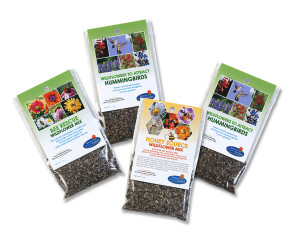
Planting a lot of reds and purples in your garden and hanging hummingbird feeders around your yard will attract and help feed these little pollinator friends. In fact, BBB Seed has a Hummingbird Wildflower Mix specifically designed with these little guys in mind.  Please help to support these amazing creatures in your own backyard!

Hummingbird Favorites:

• Penstemon
• Columbine
• Delphinium
• Autumn Sage
• Four O’clock (Mirabilis jalapa)

• Scarlet Monkeyflower (Mimulus spp.)
• Texas Sage (Salvia coccinea)
• Chuparosa
• Ocotillo
• Tree Tobacco (Nicotiana glauca)
• Baja Fairy (Calliandra californica)
• Bottlebrush
• Desert Willow

• Scarlet Gilia (Ipomopsis aggregata)
• Lantana
• Agave
• Lily of the Nile

FUN LINKS:


Video on Hummingbird Tongues

Hummingbird Coloring Pages for Children


Wildflower seed mixes

Wildflowers for pollinators

Bee flower mixes

Bumblebees Love Purple

Why Do Bees Have a Favorite Color?

by Sandy Swegel


I visited one of my favorite suburban lawn alternative gardens yesterday.  It’s a true pollinator’s heaven of nectar and pollen, right on a neighborhood street. Full of perennial gaillardia and rudbeckia, and reseeding annual larkspur, cleome and sunflower, the garden uses about the same amount of water as your average lawn.

Bees were everywhere.  Neighbors stop by in wonder at what can be done with a front yard instead of plain old grass.  In the median strips in front of the flowers, kales and lettuces produced greens for the neighbors. This time of year, gaillardia and rudbeckia are dominant with their yellows, oranges and reds.  But something different this year was a plethora of purple larkspur.  Curious, I  asked community urban farmers Scott and Wendy about the variation.  They and the landowner are all careful gardeners, unlikely to throw in something different without a reason.  Scott explained matter-of-factly, “Well it’s for the bumblebees. They prefer purple.”  I was skeptical since I see bumblebees all day on different colored flowers.  He assured me they had watched the field the last couple of years. The bumblebees always went for the purple flowers.  And walking on the path, huge fat bumblebees were on the purple larkspur, gorging away.


I couldn’t resist a little more research and sure enough, studies in Germany showed that baby bumblebees love purple flowers. Purple flowers are thought to contain more nectar than other colors and that baby bumblebees who chose purple flowers had a better chance of survival…they then passed the purple preference onto their offspring.

I’m not sure what most piqued my curiosity this day…I loved learning that bumblebees like purple flowers best.  But I think I was more intrigued by Wendy and Scott just noticing all season that the bumblebees liked one particular color.  In the end, though, I’m most impressed with the bumblebees who somehow got the humans to plant their favorite food.  Very clever bees.

Photo credits:
http://phenomena.nationalgeographic.com/2013/02/21/bees-can-sense-the-electric-fields-of-flowers/